
In short
Andrea Branzi (1938 to 2023) was an Italian architect, designer and theorist, and one of the leading voices of radical design. He co-founded Archizoom Associati in Florence in 1966 and contributed to No-Stop City, a critique of the modern city and the domestic interior. In the 1970s he took part in Global Tools and worked with Studio Alchimia, and in the 1980s he designed for Memphis and developed the Domestic Animals series with Zabro. His furniture is best read as a set of proposals about domestic life rather than as decoration. His objects make most sense when read alongside his writing, his teaching and the groups he belonged to.
Andrea Branzi is often introduced through a handful of objects, yet furniture was only one part of a career that also took in architecture, teaching, exhibition-making and a substantial body of writing. Born in Florence in 1938, he graduated in architecture there in 1966, the year he co-founded Archizoom Associati. From that point until his death in Milan in 2023, he kept returning to one question: what is a home, and what can an object say about it?
This guide explains who Andrea Branzi was, which projects define his work, and how his pieces relate to the movements around him. It covers Archizoom Associati and No-Stop City, the collective workshops of the 1970s, the Memphis years and the Domestic Animals series. It also gives practical reference points for reading a piece: the maker, the date, the materials and the edition.
Contents
Who was Andrea Branzi and why does he matter?
Andrea Branzi was an Italian architect, designer, writer and teacher, born in Florence in 1938 and died in Milan in 2023. He matters because he used design to question the domestic interior rather than simply to furnish it. After graduating in architecture in 1966, he co-founded Archizoom Associati, which stood with Superstudio at the centre of Italian radical design in the late 1960s. When Archizoom ended in 1974, he continued as a designer, a teacher and a theorist. In 1982 he was among the co-founders of Domus Academy in Milan, a postgraduate school of design.
A designer who also wrote and taught
Branzi’s texts are as important to his reputation as his objects, and the two cannot be separated without losing something of each. His writing returned repeatedly to the relationship between the home, the city and the natural world, and later developed into his reflections on what he called a weak and diffuse modernity. Over his career he worked with producers such as Poltronova, Zabro, Cassina, Alessi and Artemide, as well as in experimental contexts where the object was closer to a statement than to a product. For a collector, this means that a Branzi piece is rarely only a chair or a lamp: it usually belongs to a line of thought that can be traced and read.
Curious about the pieces behind the ideas? Browse the works presented by downtown+ to see how radical design takes material form.
What were Archizoom Associati and No-Stop City?
Archizoom Associati was a Florentine radical design group founded in 1966 by Andrea Branzi, Gilberto Corretti, Paolo Deganello and Massimo Morozzi. No-Stop City, developed between 1969 and 1971, was its best-known project: a proposal for a continuous, endlessly repeatable urban field rather than a city of separate buildings. Inside such a field, home, work and public space cease to be distinct categories, and the interior becomes a uniform, artificially lit environment. Dario and Lucia Bartolini joined the group in 1968, and Archizoom ended in 1974. No-Stop City should be read as a critique of modern urbanism, not as a plan intended to be built.
Key points
Archizoom Associati was founded in Florence in 1966 and ended in 1974. No-Stop City (1969 to 1971) imagines a continuous urban field in which home, work and public space are no longer separate. The group’s furniture, including the Superonda and Safari sofas, the Sanremo lamp and the Mies chair, was produced by Poltronova in the late 1960s.
The same logic that shapes No-Stop City runs through Archizoom’s furniture. The Superonda sofa, the Safari sofa and the Mies chair, all produced by Poltronova in the late 1960s, treat the domestic object as a provocation as much as a seat. The Mies chair, designed around 1969, reworks a modernist language of seating with deliberate irony. In 1972 the group’s work was shown to an international audience in the exhibition The New Domestic Landscape at the Museum of Modern Art in New York. Viewed in this context, a piece such as the Safari sofa is best understood as a proposal about living rather than as a sofa designed to fill a corner.
Domestic Animals and beyond: how did Branzi’s practice develop after Archizoom?
After Archizoom, Branzi moved through collective workshops, experimental design studios and furniture series. Global Tools (1973), Studio Alchimia (from 1976), Memphis (during the 1980s) and the Domestic Animals series (from 1985) are the main reference points. Each of these contexts had its own aims, and it helps to keep them distinct when you look at a piece. The groups are best understood as overlapping networks of the Milanese avant-garde, in which Branzi was a participant and a theorist rather than a single author.
- Global Tools began in 1973 as a network of experimental workshops. Archizoom, Superstudio, Gaetano Pesce and Ettore Sottsass were among those involved, and the workshops favoured direct work with materials over professional training.
- Studio Alchimia was founded in Milan in 1976 by Alessandro Guerriero, and Branzi made experimental objects in its orbit in the late 1970s.
- Memphis was a separate collective, and Branzi designed for it during the 1980s. Its bright, decorative language is easy to recognise and easy to mistake for his own thinking, which concerned domestic life more than ornament.
- Domestic Animals is the series that most clearly joins his theory and his furniture, as described below.
Domestic Animals: raw branches against industrial forms
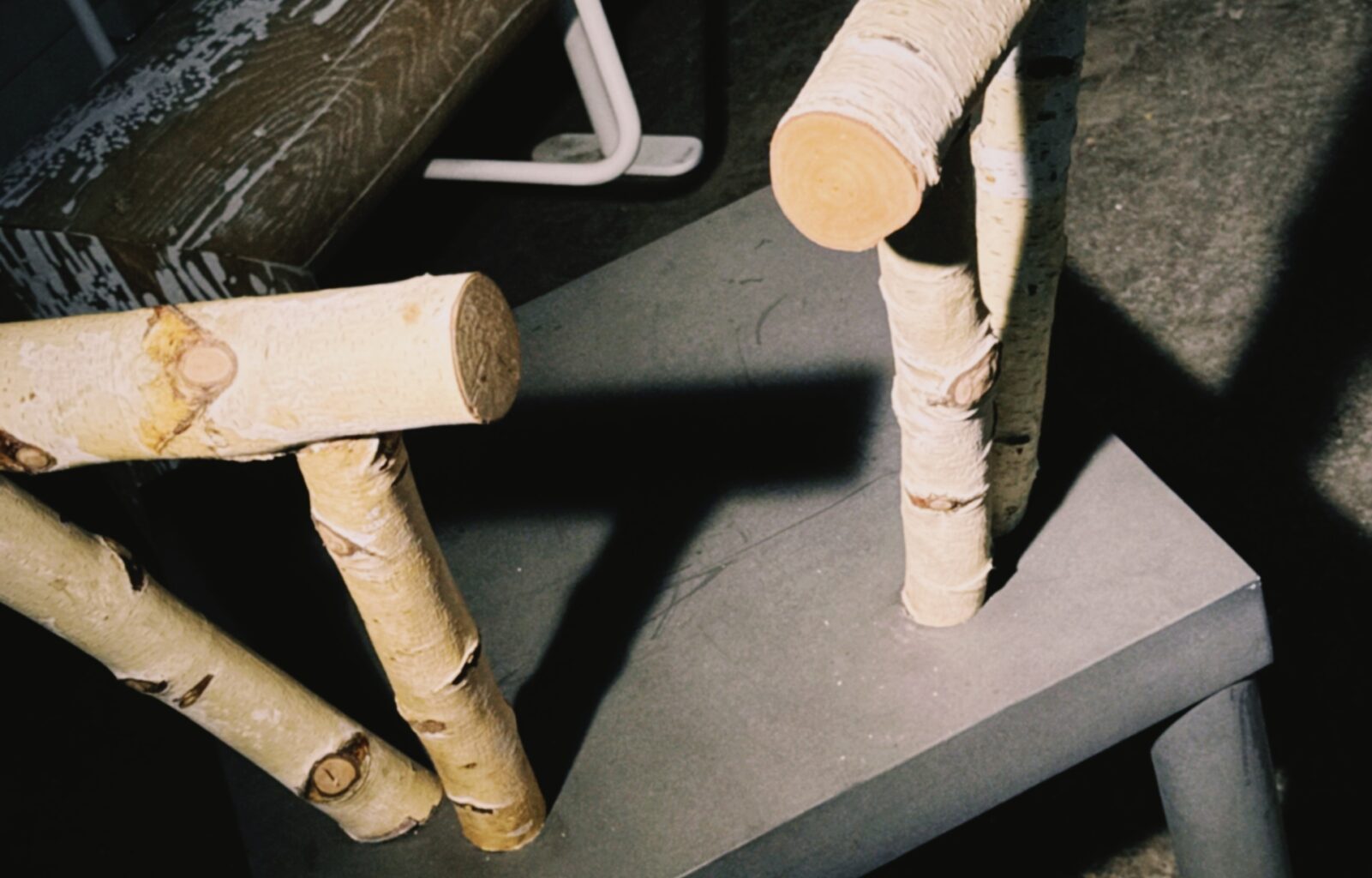
The Domestic Animals series, begun in 1985, was produced by Zabro, the experimental division of Zanotta. It sets rectilinear, industrially made structures against logs, branches and offcuts of wood that are left unfinished. Nature and industry are placed side by side without being reconciled, and the branch remains a branch. This unresolved contrast breaks with the polished surfaces of standard design, which is precisely its purpose. Because the series was made in specific runs by a specific maker, any piece should be checked against documentation, provenance and the opinion of a specialist, never by appearance alone.
| Date | Project | Nature of the project |
|---|---|---|
| 1966 | Archizoom Associati | Radical design group founded in Florence |
| 1969 to 1971 | No-Stop City | Archizoom’s proposal for a continuous urban field |
| 1973 | Global Tools | Network of experimental workshops in Milan |
| From 1976 | Studio Alchimia | Milan studio founded by Alessandro Guerriero |
| 1980s | Memphis | Separate collective for which Branzi designed |
| From 1985 | Domestic Animals | Furniture series produced by Zabro |
Interested in the wider radical design lineage? Explore the designers who shaped it, starting with Andrea Branzi.
How do Andrea Branzi’s objects sit beside contemporary art?
Andrea Branzi’s objects sit comfortably beside contemporary art because they were conceived as proposals rather than as decoration. A Domestic Animals chair or an Archizoom seat carries an argument about domestic life, so it can face a painting as an equal instead of acting as a backdrop. In the Domestic Animals series, raw branches rest on a rectilinear industrial frame and neither material gives way to the other. That tension is close to the logic of much contemporary sculpture, where the nature of the material is part of the subject. Looking at a Branzi piece this way also protects against reading it as a purely decorative accent.
downtown+ presents pieces by designers of this lineage, and you can discover Andrea Branzi’s page or browse the wider group of designers presented to follow the connections between them.
A Branzi object is a proposal about domestic life, and it gains its weight from the theory that stands behind it.
Branzi mattered as a thinker as much as a maker, and his furniture is the most visible trace of ideas that began with Archizoom and No-Stop City. The most reliable way to approach a piece is to identify its maker, its date and its context, and to ask for documentation and provenance when any of these is unclear. A specialist’s expertise remains the final reference for attribution. With these points established, the object can be read for what it argues rather than only for how it looks.
Would you like to discuss Branzi’s work? The team is available to continue the conversation about the pieces and the ideas behind them.
Frequently asked questions
What is Andrea Branzi best known for?
Andrea Branzi is best known as a co-founder of Archizoom Associati and as a leading theorist of Italian radical design. His name is linked to No-Stop City, to the Domestic Animals series and to his teaching and writing.
He was also a co-founder of Domus Academy in Milan in 1982. His furniture is the most visible part of his work, but it follows from a wider body of ideas about the home and the city.
What is the Domestic Animals series by Andrea Branzi?
Domestic Animals is a furniture series begun by Andrea Branzi in 1985 and produced by Zabro, the experimental division of Zanotta. It combines rectilinear, industrially made structures with logs, branches and offcuts of wood left in a raw state.
The natural material is never smoothed into the industrial frame. The contrast is the point of the series, which sets nature and industry side by side without resolving them.
How does Andrea Branzi’s work differ from Memphis?
Memphis was a separate collective, while Branzi was a theorist and designer who worked with it during the 1980s among many other contexts. Its bright and decorative language is easy to recognise, but it does not define his thinking.
Branzi’s central concerns were domestic life, the city and the relationship between objects and nature. When a piece looks Memphis-like, the maker and the date should be checked before it is attributed to him.
What was No-Stop City?
No-Stop City was a project developed by Archizoom Associati between 1969 and 1971, with Andrea Branzi as one of its authors. It proposed a continuous, repeatable urban field in which home, work and public space are no longer separate categories.
It is a critique of modern urbanism rather than a plan to be built. The same logic of repetition and dissolution can be recognised in Archizoom’s furniture.
How can you tell an original Branzi or Archizoom piece from a later edition?
No single visual detail is enough to tell an original from a later edition, so the principle is to rely on documentation, provenance and the opinion of a specialist. The maker, the date of production, the materials and any edition information should all be consistent with what is known about the design.
Archizoom’s furniture was produced by Poltronova and the Domestic Animals series by Zabro, which gives a first point of reference. If a piece cannot be placed with confidence, a qualified expert should be consulted before any attribution is accepted.