
In short
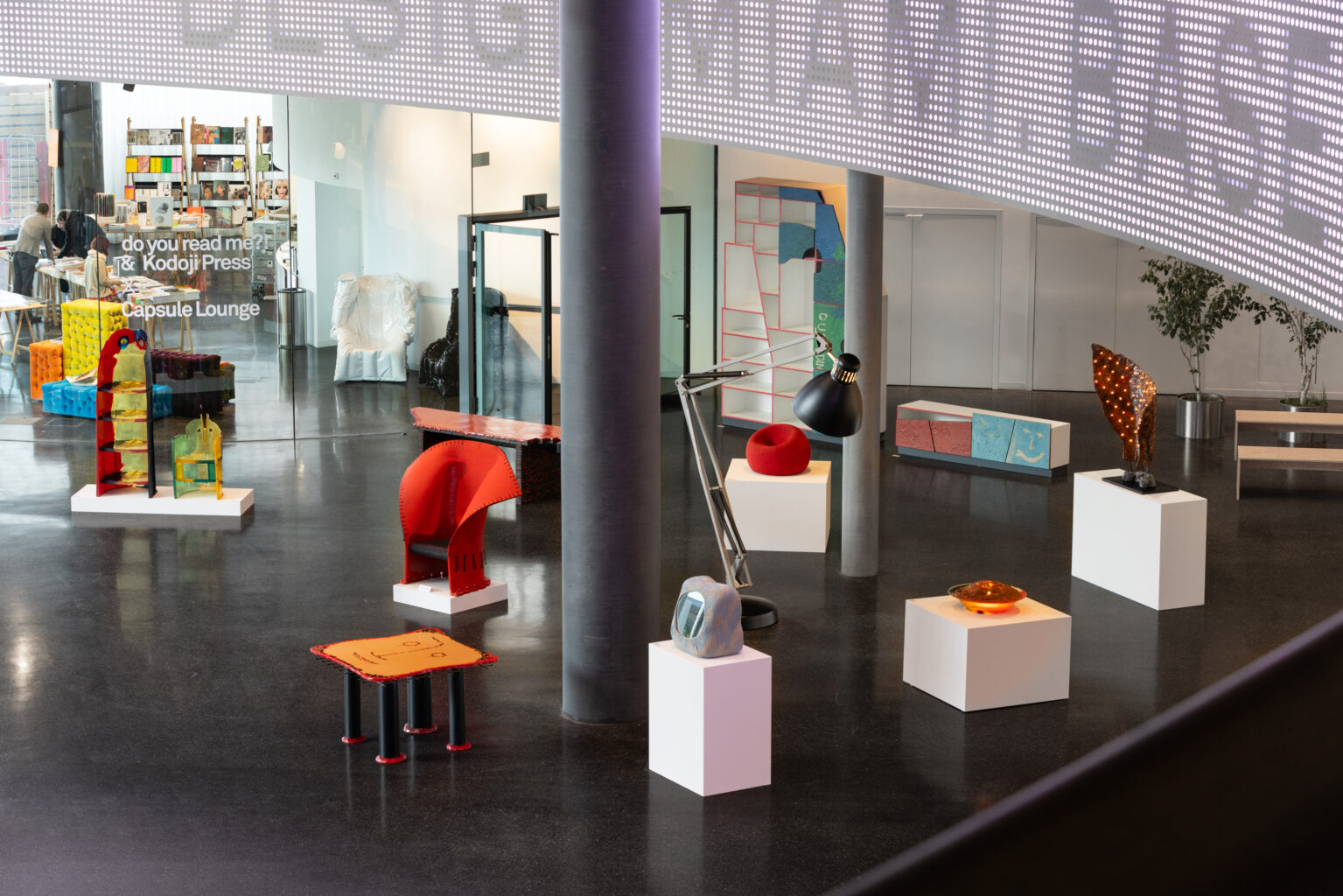
Sculptural furniture is furniture in which form and presence carry as much weight as function, while the piece remains usable as a seat, a table or a storage unit. The form comes from the structure and the material rather than from applied decoration. The category took shape with the Italian radical designers of the 1960s and 1970s, and it was extended by Memphis, by Gaetano Pesce’s resin work and by contemporary designers such as Tokujin Yoshioka. A reliable test asks two questions: does the shape arise from how the piece is built, and does the piece still work? The fifteen pieces below, from the Superonda sofa to the Honey-pop armchair, show how the idea has evolved over six decades.
Many unusual chairs are described as sculptural, yet an eccentric silhouette alone does not make sculptural furniture. The term describes pieces whose volume, proportions and material give them the presence of a sculpture, without ceasing to be functional objects. It is one of the clearest places where art and design overlap.
This guide sets out a working definition, explains how material and making produce sculptural form, and presents fifteen pieces by designers and collectives whose work is well documented. It also explains how to distinguish a unique piece, a limited edition and a later reissue, a distinction that matters to any collector.
Contents
What makes furniture sculptural?
Furniture is sculptural when its form and visual presence take the central role, while it keeps its function. The object is read as a volume in space before it is read as a chair, a cabinet or a table. This does not mean that use is abandoned: the best examples are those in which the sculptural quality and the function cannot be separated.
The idea has a clear historical background. In the 1960s, Italian radical designers began to treat furniture as a vehicle for ideas, and to question the modernist principle that form follows function. Their pieces were often produced industrially, which is what distinguishes them from the craft object or the pure artwork.
A simple test: form, structure and use
Two questions help to separate sculptural furniture from merely eccentric furniture. First, does the form come from the structure and the material, or has it simply been added to a conventional frame? Second, does the piece still do what furniture does? A shape that only decorates a conventional chair fails the first question, and an object that cannot be sat on fails the second.
Proportion is a further indicator. Sculptural pieces often push height, depth or curvature beyond the norm, and they rely on a substantial base or a continuous volume to hold the whole form together. Looking at the silhouette from several sides, as you would with a sculpture, quickly shows whether the piece has been conceived in the round.
Drawn to furniture that behaves like sculpture? Discover the pieces presented by downtown+ at the crossing of design and contemporary art.
How do material and making shape sculptural furniture?
In sculptural furniture, the material often generates the form instead of covering it. Polyurethane foam, cast resin, felt, laminate, polycarbonate and paper have each produced distinctive volumes, because each behaves differently when it is poured, compressed, stiffened or folded. Understanding the material is therefore the quickest way to understand why a piece looks as it does.
Gaetano Pesce is the clearest example. His Up series of 1969 used polyurethane foam that was compressed for transport and expanded on opening, and his later work in cast resin allowed colour and form to be fixed in a single pour. Because the resin is worked by hand, the surface and tone can vary between pieces made from the same mould, so each object carries traces of its making.
Key points
The form should arise from structure and material, not from applied ornament. The piece should remain usable as furniture. The making should remain legible: a poured surface, a visible seam or an exposed structure tells you how the object was produced. Look at the piece from several angles, as you would a sculpture.
Production method also shapes the object. A laminate cabinet by Memphis, a polycarbonate chair by Philippe Starck and a hand-poured resin chair are all sculptural, but they belong to different economies: industrial production, large-scale series and near-unique work. Recognising which one you are looking at is the basis of any serious comparison.
Which pieces define sculptural furniture?
Fifteen pieces give a reliable overview of the category, from the radical experiments of the 1960s to contemporary design. They are chosen because their dates, designers and materials are well documented, and because each one resolves the relation between form and function in a different way. Exact production dates vary between versions and editions, so the table gives the design period rather than a single year where it is uncertain.
- The silhouette: a continuous or exaggerated volume that holds up from every side.
- The structure: the form follows from how the object is built, folded, poured or assembled.
- The material: foam, resin, felt, laminate or paper chosen for its sculptural behaviour.
| Piece | Designer | Period, material and producer |
|---|---|---|
| Superonda sofa | Archizoom Associati | 1966, polyurethane foam, Poltronova |
| Superbox | Ettore Sottsass | Mid-1960s, plastic laminate, Poltronova |
| Up series | Gaetano Pesce | 1969, polyurethane foam, C&B Italia |
| Mies chair | Archizoom Associati | 1969, steel and upholstery, Poltronova |
| Ultrafragola mirror | Ettore Sottsass | 1970, shaped mirror with lighting, Poltronova |
| Quaderna table | Superstudio | 1970, laminate with grid surface, Zanotta |
| Carlton bookcase | Ettore Sottsass | 1981, laminate and wood, Memphis |
| Casablanca sideboard | Ettore Sottsass | 1981, laminate and wood, Memphis |
| Pratt chair | Gaetano Pesce | Early 1980s, cast resin |
| Animali Domestici series | Andrea Branzi | 1985, raw wood with manufactured elements |
| Hamletmachine chair | Bob Wilson | Around 1986, designed for the stage |
| Feltri armchair | Gaetano Pesce | 1987, resin-stiffened felt, Cassina |
| Honey-pop armchair | Tokujin Yoshioka | 2001, folded paper structure |
| Louis Ghost chair | Philippe Starck | 2002, transparent polycarbonate, Kartell |
| Nobody’s Perfect chair | Gaetano Pesce | Early 2000s, resin |
Radical and postmodern Italian pieces
Archizoom Associati approached furniture as critique. The Superonda sofa, with its undulating foam form, and the Mies chair, which plays on the language of Modernism, treat the domestic interior as a field of ideas. Ettore Sottsass moved from the laminate monoliths of the 1960s to the Ultrafragola mirror, and then to the Carlton bookcase and Casablanca sideboard produced by Memphis in 1981. These last two are often grouped with the radical designs of the 1960s and 1970s, but they belong to Memphis, a separate collective, and to the postmodern period.
The Quaderna table by Superstudio applies the logic of the grid to a domestic surface, while Andrea Branzi’s Animali Domestici series of 1985 brings raw wood into dialogue with manufactured elements. In each case the object is conceived as an idea in three dimensions, and its function is the starting point rather than the purpose.
Resin, felt, paper and polycarbonate
The later pieces show how material alone can create a sculptural form. Pesce’s Feltri armchair uses felt stiffened with resin, and the Pratt chair and Nobody’s Perfect chair use cast resin. Tokujin Yoshioka‘s Honey-pop armchair is formed from folded paper that opens into a honeycomb structure, and Philippe Starck’s Louis Ghost chair reduces a historical Louis XVI form to a single transparent polycarbonate volume. Bob Wilson‘s Hamletmachine chair, designed around 1986, comes from a different logic: it is furniture conceived for the stage, and it is best read alongside the scene it belonged to.
Curious about the designers behind these forms? Explore the designers and collectives whose work moves between art and design.
How do you tell a unique piece from an edition or a reissue?
A unique piece is made once, a limited edition is produced in a set number of copies, and a reissue is made later under licence, often with a different date and sometimes with modified materials. These categories matter because the same design can exist in all three states. The Ultrafragola mirror, for instance, was designed in 1970 by Ettore Sottsass for Poltronova, so the design date alone does not tell you when a given example was made.
Four facts should be established for any piece: the designer, the model, the maker and the production date. Where a piece is described as a unique work, a prototype or a numbered edition, the supporting documentation and provenance should be examined, and the opinion of a specialist is the appropriate way to confirm attribution. A prototype is a test model made before production, and a period original is a piece made in its own time by the original producer.
A sculptural piece is understood through its form, its material and its status: unique work, edition or reissue.
downtown+ presents pieces by designers whose work belongs to this field, including Gaetano Pesce and Ettore Sottsass, and you can browse them on the designers page. In practice, sculptural furniture is best approached by looking closely: at the structure behind the form, at the material, and at the way the object occupies a room. Where these three elements agree, the piece is genuinely sculptural, whatever its date or edition.
Looking for a particular form or designer? Speak with the downtown+ team about the pieces and artists that interest you.
Frequently asked questions
What does sculptural furniture mean?
Sculptural furniture is furniture whose form and presence are as important as its function. It is read as a volume in space, and its shape arises from the structure and the material rather than from applied decoration.
The term covers industrial pieces, limited editions and unique works. What they share is a design in which the object holds its own as a sculptural form while remaining usable.
How can you tell whether a piece is truly sculptural?
Ask whether the form comes from the structure and the material, and whether the piece still works as furniture. If both answers are yes, the piece belongs to the category.
Look at it from several sides, check its proportions and base, and see whether the making remains visible, for example in a poured surface or an exposed structure.
What is the difference between sculptural furniture and collectible design?
Sculptural furniture describes a quality of form, while collectible design describes a field defined by historical importance, edition status and documentation. A piece can be both, but the two terms are not interchangeable.
A sculptural chair produced in large numbers is still sculptural, whereas the collectible category usually involves historical significance, limited production or unique work.
How should resin, foam or felt pieces be cared for?
Care depends on the material, so the first step is to identify exactly what the piece is made of. As a general principle, keep resin, foam, felt and paper away from strong direct sunlight, heat and damp, since these affect colour and structure over time.
For any piece of historical or collectible importance, cleaning and repair should be entrusted to a qualified conservator or restorer rather than carried out with household products.
Which designers are most associated with sculptural furniture?
Gaetano Pesce, Ettore Sottsass, Archizoom Associati, Superstudio and Andrea Branzi are central to the Italian radical and postmodern tradition. Their work established the idea that furniture could carry ideas as well as function.
More recent designers such as Philippe Starck and Tokujin Yoshioka have extended the category through new materials, including polycarbonate and folded paper.